
Stikky Wine?
The little wine book that could

Part 1
This book is a book about wine.
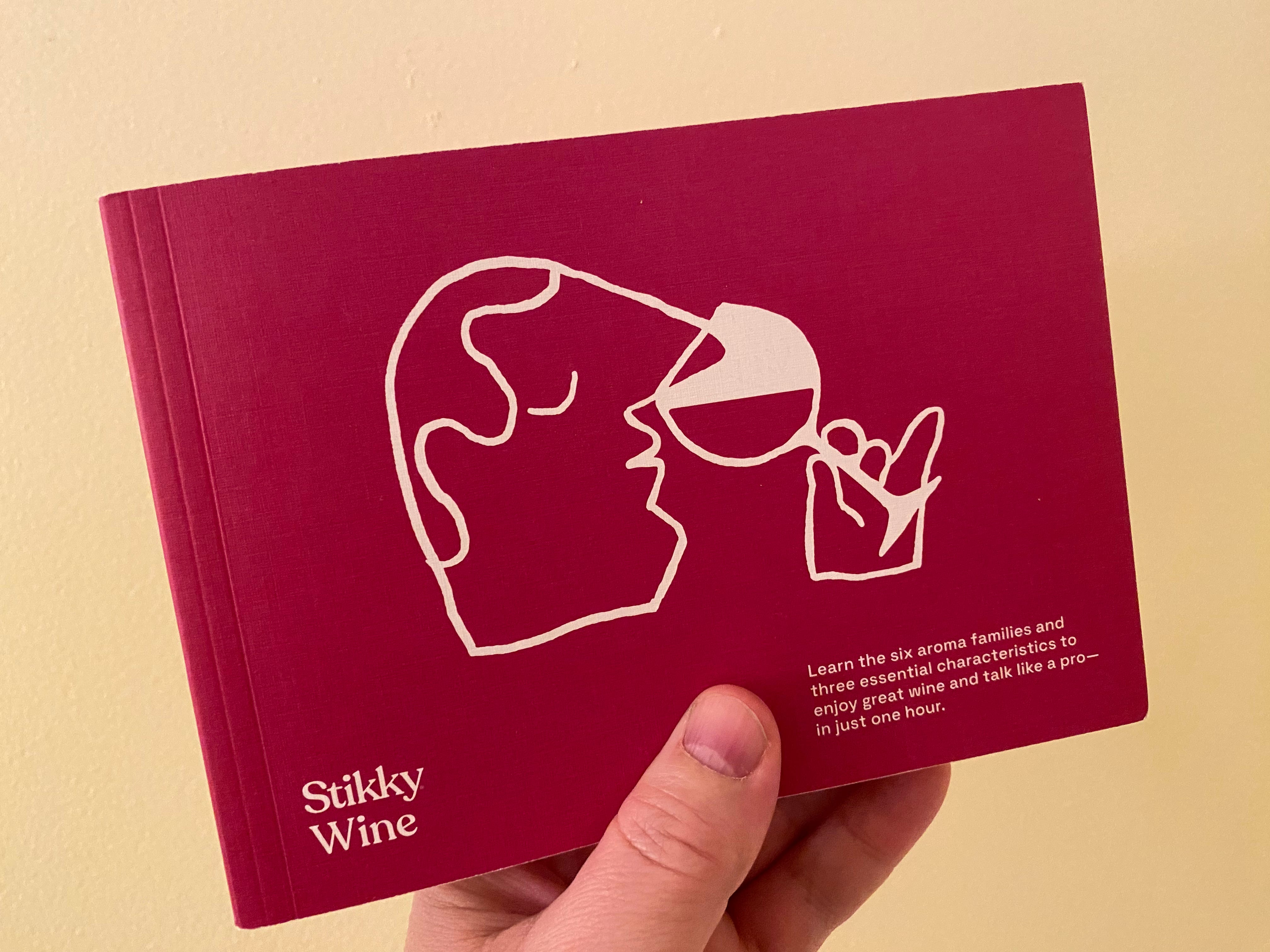
The cover makes it look like it’s a kids book, but it is not.
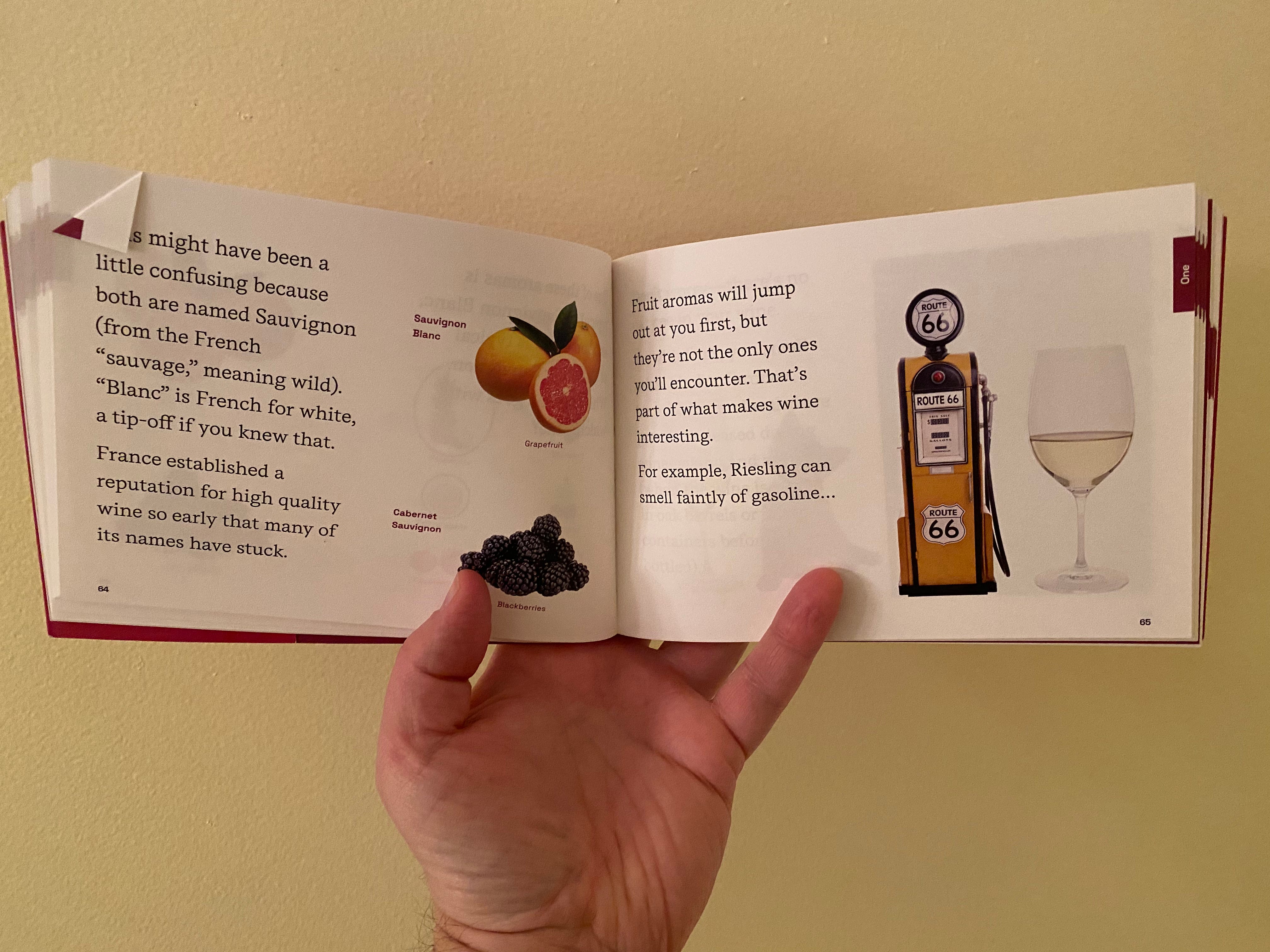
It has lots of images in it to make things easy to understand.
The images help demonstrate the things in the text.
There isn’t a lot of text, but what is there is important, easy to read and understand without sounding dumb.
Wine is not a simple topic, which makes it a challenge to explain it in a way that is simple.
If you, or someone you know, is interested in learning about wine from scratch, there isn’t a better autodidactic wine book out there.
Part 2
This book tackles a lot of things about wine appreciation, which is its main focus. It’s a bit of a weird shape and the pages are not loaded with information in the first section, which is also the longest by actual page numbers but not necessarily by how much you actually learn.
That is the way that it is structured. A little bit of information presented in a clear and simple methodical way at first, then more information added slowly afterwards, which builds on the concepts at the beginning.
The text is simple at first and there are always illustrations or photographs to help visualize the concepts in the text. These aren’t basic line drawings either. There are real photos to help drive home points that are necessary to grasp before moving on.
The concepts start simple and slowly gain complexity as you read through the pages. What I find really interesting is that no new concepts come out of nowhere. Everything has a context that has been set up. The first page doesn’t even talk about wine but rather how humans may have discovered alcohol in nature. Before the first bottle is even opened, the book has given the most basic (and necessary) context for why wine exists in the first place.
The complexities of wine make it an easy target for people who do not (or do not care) to use their senses, so explaining everything within a context is important. Nobody wants to read a book that just spouts random facts that seemingly have nothing to do with anything else. Rote memorization is what was expected when I was in high school, not reading about something fun.
This book will appeal instantly to anyone who is interested in wine but has been too overwhelmed to get started with learning about it. Search engines were around when I started learning about wine, but they did not return as much information as they do now. Information overload (from all sources) may be a part of the problem that makes learning about things more challenging since it takes more energy (in my opinion) to wade through the deluge of useless crap and algorithm-baiting than it does to thumb through an offline source like a book.
Part 3
If you’ve read this far, and you are still interested in what this book is about, you can be sure that you probably already know from the first two parts that you’ve already read. Everything I write about from now on is just the same thing with a little more complexity. It’s the same way that WSET structures it’s curriculum. Levels 1, 2, 3, and 4 all cover similar territory in the wine world but it’s the level of detail that changes, drastically in the case of level 4. Level 1 is “This is Chardonnay.” Level 2 is “This is Chardonnay from France, this is Chardonnay from California, etc”. Level 3 is “This is Chardonnay from Burgundy, this is Chardonnay from Napa Valley, etc”. Level 4 is “This is Chardonnay from Chablis and these are the laws that govern its production. This is Chardonnay from Macon and these are the laws…” etc. to include every Chardonnay production of note throughout the world.
This is how Stikky Wine presents wine - a complex subject - as something very approachable. It does it very well and the structure makes it all flow very easily from one concept to the next. It is deceptively simple. Initially, almost everything about it from the writeup to the cover put me off. Here we go again. Another book trying to make wine appear simple. At least the title of the book doesn’t call me a dummy like another strangely popular series released a few decades ago.
Wine appeals to me because it can be enjoyed on many levels. I like it and enjoy it more because it can be complex. When I don’t want to think about a wine, I don’t have to because I can enjoy it for whatever it is at the moment. If it’s just something to go with dinner and I don’t have to think about it, that’s cool too.
Compare that to enjoying cola. It is not likely that anyone will appreciate the levels of guaiacol-y goodness in the bouquet. Nor will taste variations between sips be significant enough to notice. Doing comparative tasting notes on colas (or creating a book called Skikky Cola) is to miss the whole point of the drink’s raison d’être. They are sugary glasses of refreshment that has captured multiple generations of us. I was more an Orange Crush kid though so perhaps my life truly went off the rails when I opted for that instead of a cola with my first fast-food burger.
Such was my first impression of Stikky Wine, which was only reinforced when I saw the monochrome cover. Adorned with a caricature of a male’s head, large nose in a glass of wine, eyes closed, hand gripping the upper stem of a wine glass, pinky finger extended, the cover almost reinforces the image of wines’ culturally elite snobbish past. This copy was sent to me to evaluate and maybe post a review. What had I gotten myself into?
Sticky Wine is part of a series of Stikky books on various topics, wine being the fifth in the series that also covers a rando mixture of subjects like stock charts, stars, and survival. When I started to dig into where this book originated, this diversity started to make more sense.
Though there is no author listed on the cover (or spine, or back, or inside the covers…), the copyright notice indicates that the holder is Laurence Holt Books, Inc. and owned by one Laurence Holt himself. A software engineer based out of New York, according to his LinkedIn profile, Holt has been in the industry since the mid-1980s working with a special interest in “knowledge acquisition and learning processes”. Stikky Wine, and the Stikky books series, may all be part of a proving ground for the methods he’s worked on over the years.
If so, it is done really, really well. I’m impressed. The ease at which this book presents a complex subject is admirable. Clearly, after 20 years in the wine industry, 16 years in wine media, and 7 published books about wine, I am no longer a wine neophyte. But I still love to learn and have never assumed that I know everything about wine. I still cringe when people call me a ‘wine expert’. Thumbing through the pages of Stikky Wine even taught me a few new things about the potential origins of some of the grape names. For example, most of the wine books that I’ve read have never bothered to mention anything about the origin of the names of some grape varieties, with the exception of Pinot Noir (‘pinot’ meaning ‘pine’ in French, a descriptive reference to the pinecone shape of Pinot Noir’s grape clusters). Stikky Wine brings in definitions about grape names whenever possible, which was not only interesting but I now see would have made it a lot easier to learn and recall the names of these grape varieties when I was learning them years ago. A quick glance through standard wine reference books on my shelves reveal no mention of this kind of information. Why haven’t other wine books mentioned such basic things before?
Sometimes an outsider’s perspective can be refreshing. Holt is clearly an outsider in the wine world, although he may have fostered his own interests in wine privately over the years. I’ve never met him so I can’t assume anything about his own level of wine knowledge. What he does bring is a simplicity of approach to a complex subject and the results, at least in Stikky Wine, is a refreshing take on wine. In addressing things that most wine books overlook, it’s a welcome entrance to a very large world all thanks to its outsider perspective.
The conciseness of its approach is highly refined, almost to the point of focus-group banality with all of the unique rough edges ground to a polished sheen. So while it has that simplicity of style, the core elements and methods remain intact, which is great because the book really does what it purports to do - teach people about wine. I’m not expert in teaching methods but the frequent repetitions and parallels to non-wine things (milk, beer, pop culture) surely help readers recall important facts. There are excellent photos and illustrations throughout and the pace increases as the book progresses through the approximately 240 pages. There are extensive references at the back, including a short list of books, apps, podcasts, and websites so that readers can continue their journey if they desire.
The elephant in the room with books like this today is how much of it was actually created by a person, and does it really matter? All of the hands in the photos have the correct number of fingers so it is unlikely AI generated images were used. The text could have been generated but, with such a consistent approach and style throughout, seems doubtful to me at this point, although I’m no expert on that either. If there are AI elements, it is still an impressive book with the educational elements properly in place. As we get into 2026, it seems that less and less people really care where it comes from. Again, I’m no AI expert, but I do know how long it takes to get a book into print and I assume that technology is supposed to produce things more quickly and easily. Holt could presumably have ramped up production of these things a lot faster in recent years. With only five books in the series so far, that doesn’t seem to be the case.
In summary, this is a great book for the uninitiated. AI or not, it will do what it says it will using its educational elements and structure that progresses from simple to complex. It’s a fun read that will become a handy reference to keep on the shelf for years after. Sip, read, enjoy!
I enjoyed this by listening to the English vocal. I like that some wine writers enjoy sharing their experiences and stories and have humour doing so. Hope to have a copy someday.